About My Home Life
Find out how it started and learn about the core work of My Home Life Northern Ireland.
Find out how it started and learn about the core work of My Home Life Northern Ireland.
My Home Life Northern Ireland is part of a wider international initiative which aims to promote quality of life and deliver positive change in care homes.
Each international partner works independently, although research findings and resources are shared with other partners, the care home sector, and stakeholders through the My Home Life Charity website (Registered charity, No. 1187498).
In Northern Ireland, the My Home Life initiative is the delivery of a Leadership Support Programme alongside a Quality Improvement component. The Programme is led by Ulster University in partnership with Age NI and the Independent Health Care Providers (IHCP).
My Home Life has worked with over 60 academic researchers from universities across the UK to develop the evidence base that enhances quality of life in care homes. The review explored ‘what residents want from care homes’ and ‘what practices work in care homes.’ The evidence clustered around eight best practice themes (National Care Homes Research & Development Forum, 2007).
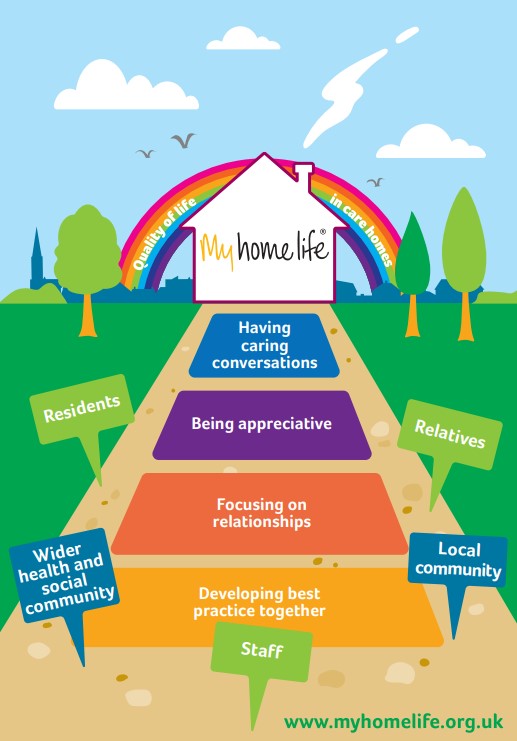
Alongside the eight themes, the evidence base includes relational, appreciative, and collaborative approaches that foster and exemplify a positive culture of mutually respectful relationships, and developed into four overarching frameworks:
The My Home Life initiative began in England in 2006 as a small project to synthesise the literature on best practice in care homes.
Since then, it has grown into a social movement aiming to promote quality of life for those who are living, dying, visiting and working in care homes for older people. Over the past two decades My Home Life has developed an international reputation for facilitating positive culture change and enabling care homes to both professionalise and articulate their expertise. In the UK My Home Life launched in Wales in 2008, Scotland in 2012 and Northern Ireland in 2013.
In Northern Ireland, the Programme began with a Knowledge Transfer Grant awarded to Professor Assumpta Ryan (Ulster University) from the Research and Development Office of the Public Health Agency. It enabled the introduction of My Home Life to Northern Ireland by a team of researchers in Ulster University School of Nursing and Paramedic Science, and the delivery of the first cohort in 2014 - 2015.
Over the next four years, funding was secured to continue to deliver one cohort per year, allowing the My Home Life Programme to become established and expand gradually. In Year 2, Programme delivery was supported by funding with IHCP and Age NI, in collaboration with Ulster Garden Villages. In Year 3, a single care home organisation funded the Programme to be delivered across several of its homes. By Year 4, growing evidence of the Programme’s impact and increased confidence in its value led participating care home organisations to partially fund delivery, with additional funding support from Age NI. In Year 5, funding from the Chief Nursing Officer, combined with contributions from participating organisations and continued support from Age NI, enabled the ongoing delivery of the Programme and the creation of a quality improvement resource.
During Year 6 (2020 -2021), following a successful funding bid to the Department of Health, the Programme was delivered to one cohort and with additional funding allocated for engagement with the wider care home sector across Northern Ireland. Engagement sessions in all trust areas focused on the benefits for residents, relatives and staff, as well as the wider health and social care sector.
Years 7 - 11 (2021–2026), Department of Health funding enabled significant scaling-up of Programme delivery, where all care home across Northern Ireland were offered the opportunity to participate. Each year five cohorts of approximately 100 participants would join the Programme:
Year 7: Cohorts 7–11
Year 8: Cohorts 12–17
Year 9: Cohorts 18–22
Year 10: Cohorts 23–27
Year 11: Cohorts 28–32
In June 2025, 365 individuals have completed the My Home Life Programme. This figure is expected to increase significantly with the completion of participants from Cohorts 28-32 in June 2026.
Additional My Home Life - Funded Activities
Chief Nursing Officer funded the completion of a My Home Life literature review exploring the factors that enable or inhibit care home residents’ and families’ engagement in decision-making about care and support. In addition, My Home Life Northern Ireland has contributed to a range of key initiatives within the care home sector:
The My Home Life team are grateful for the ongoing support of all our stakeholders in improving the quality of life for those living, dying, visiting, and working in nursing and residential homes. We would like to especially acknowledge the Department of Health and our partners: Ulster University, Age NI, Northern Ireland Social Care Council (NISCC), Regulation and Quality Improvement Authority (RQIA), Patient and Client Council NI (PCC-NI), Independent Health & Care Providers (IHCP), and the Public Health Agency (PHA).
A final word from the Department of Health, Heath Minister, Mike Nesbitt:
"Ulster University’s delivery of the My Home Life (MHL) Leadership Support Programme for Care Homes on behalf of the Department, has been one of the key drivers in improving the quality of life for care home residents, relatives and staff across Northern Ireland (NI) since 2013."
MHL Areas of work include:

Research and quality improvement, with a particular emphasis on collaborative action research, facilitated through the development and use of creative and inclusive methods.
Developing educational and practice resources, and creating the conditions for their translation and use.
Leadership support to enable care home leaders to empower staff and to foster relationship-centred cultures within their care homes.
Community engagement to strengthen relationships between care homes and their local communities.
Engaging and influencing at national level through stakeholder engagement and social action, highlighting the implications of systemic failure to properly value care in policy or in wider society and evidencing the need to afford staff the time, space, resources and recognition required if they are to flourish in increasingly complex environments.